
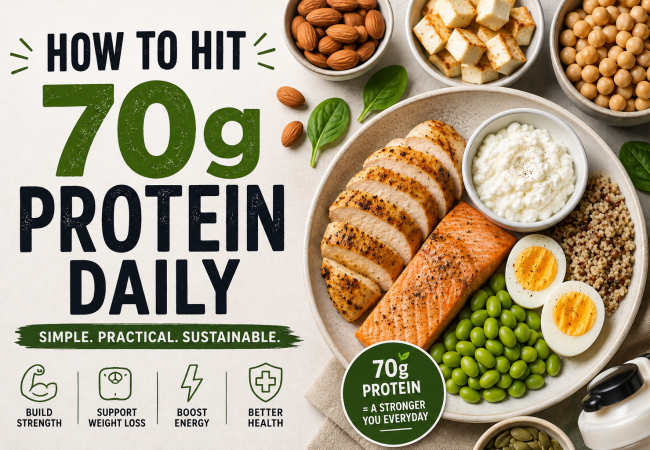
How To Hit 70g Protein Daily
If you’ve ever tracked your protein intake for a day, there’s a good chance the number shocked you. Most Indians — vegetarian or not — eat far less protein than they think, and it quietly shows up as slow metabolism, constant hunger, hair fall, and sluggish recovery from workouts.
The usual fix people reach for is eggs, whey protein, or chicken breast on repeat. But what if you’re vegetarian, sensitive to eggs, don’t enjoy the taste of protein powder, or simply want your protein to come from real, traditional food?
In 15+ years of practice — working with 5,000+ clients on gut health, PCOS, insulin resistance, and weight loss — I’ve learned that the biggest protein wins don’t come from adding exotic supplements. They come from swapping the high-fat, high-carb staples already on your plate for cleaner, more bioavailable versions of the same foods.
Here is a plan similar to what I share with my clients to hit 70g of protein a day — no eggs, no protein powder, no meat, and without upsetting your gut.
For an average adult, a good working target is roughly 0.7-0.8g of protein per kg of body weight for general health, going up to 1.0-1.5g/kg if you’re active, trying to build muscle, or managing insulin resistance and PCOS. For most Indian women and men in the 55–75kg range, that lands somewhere between 60–90g a day —
Here’s the part most people miss: protein isn’t just about muscle. It’s about satiety, blood sugar stability, and gut lining repair. A gut-friendly high-protein day should also be:
Low in unnecessary fat (so digestion stays light)
Moderate and high-fibre in carbs (so blood sugar doesn’t spike)
Built from whole, traditional foods your gut already recognises
That’s exactly what this plan does.
What it is: One glass of chaach (spiced buttermilk) blended with roasted gram (chana) flour, i.e. sattu. Start with 2tbsp sattu and 100gms curd or 250ml chaach
Nutrition snapshot: Sattu is one of the most underrated protein sources in the Indian pantry — roughly 20g of protein per 100g, along with slow-digesting complex carbs, fibre, and a naturally low glycaemic index, which makes it ideal for insulin resistance and PCOS clients. Buttermilk adds probiotics and easily digestible proteins without the fat load of full cream milk.
Fun fact: Sattu has been called “the poor man’s protein” for centuries in Bihar and eastern Uttar Pradesh. Legend has it that soldiers and travellers in ancient Magadh carried sattu on long journeys because it didn’t spoil, needed no cooking, and kept them full and cool through scorching summers — possibly one of India’s earliest “protein shakes,” invented long before the fitness industry existed.
What it is: A savoury pancake made from 50g raw moong dal batter, stuffed with 60g grated low-fat paneer.
Nutrition snapshot: Raw moong dal carries about 24g protein per 100g, and because it’s a split, skinned lentil, it’s one of the gentlest proteins on digestion — exactly why it’s the go-to dal in Ayurveda for anyone recovering from illness. Low-fat paneer contributes another 12–15g protein per 100g while keeping saturated fat significantly lower than regular paneer. Together, this dish alone can deliver close to 20g of protein, and combined with the sattu chaach, this meal comfortably crosses 25–30g of protein before 10am.
Fun fact: Paneer is technically not a “true” cheese by Western standards — it’s made by curdling milk with an acid like lemon juice or vinegar rather than rennet, which is why it doesn’t melt when heated. This makes it one of the few cheeses in the world that’s naturally vegetarian-friendly, and a staple across North Indian households for exactly that reason.
What it is: Skyr yogurt (or thick, low-fat hung curd) mixed with cold boiled rice, tempered with mustard seeds, curry leaves, and green chilies in just ½ tsp oil.
Nutrition snapshot: This is a smart upgrade on a South Indian classic. Regular curd has around 3–4g protein per 100g, but Skyr — a strained, thicker yogurt — packs closer to 10–11g protein per 100g, nearly triple the protein for the same volume, while keeping fat low. Add the tempering, and this bowl delivers a gut friendly easy to digest protein bowl.
Fun fact: Curd rice (thayir sadam) is traditionally eaten as the last course in a South Indian meal, not as an afterthought, but because Ayurveda and Tamil food culture consider it a natural coolant that aids digestion after a heavy meal. It’s also offered as prasadam at temples like Tirupati — proof that “gut-friendly eating” has been part of Indian food wisdom for centuries, long before the word “probiotic” existed.
What it is: One bowl of roasted fox nuts (makhana) with 5 soaked almonds.
Nutrition snapshot: Makhana is a genuinely excellent snack for anyone watching fat and calories — it offers about 9.7g protein per 100g while staying naturally low in fat, plus a good dose of magnesium and potassium, both important for muscle recovery and blood pressure regulation. Almonds are calorie-dense (so portion matters), but 5 soaked almonds add roughly 1.5–2g of extra protein along with healthy fats and vitamin E.
Fun fact: Makhana is grown almost entirely in the wetlands of Bihar’s Mithila region, and India’s Makhana recently received a GI (Geographical Indication) tag for exactly this reason. It’s also a traditional “vrat” (fasting) food during Navratri — because botanically, it’s classified as a fruit seed, not a grain, making it permissible during fasts where grains are avoided.
What it is: 150g firm tofu tossed with broccoli and bell peppers.
Nutrition snapshot: Firm tofu offers roughly 8–12g protein per 100g depending on firmness, so 150g alone can deliver close to 15g of protein, with almost no saturated fat — one of the lightest ways to end the day protein-heavy without weighing down digestion before bed. Broccoli and bell peppers add vitamin C, which helps improve the absorption of plant-based iron and protein from the same meal.
Fun fact: Tofu is made almost exactly like paneer — by curdling a plant “milk” (soy milk) instead of dairy milk. It’s essentially soy’s answer to paneer, which is why it slots so naturally into an Indian kitchen. Interestingly, India isn’t new to soy protein either — Madhya Pradesh is one of the world’s largest soybean-producing regions, and Indian-made soya chunks (popularly known by the brand name Nutrela) have been a budget-friendly vegetarian protein staple in Indian households since the 1970s.
The secret isn’t adding more food — it’s swapping high-fat, high-carb traditional staples (think regular paneer, full-fat curd, deep-fried snacks) for their cleaner, high-protein versions, while keeping the meals recognisably Indian.
If you want to build variety into this plan over the week, here are a few more desi, vegetarian-friendly protein sources I recommend to clients:
For Indians living abroad, this plan is actually easier to execute than it looks:
Skyr is widely available in the US, UK, and most of Europe (often cheaper than in India)
Firm tofu is a supermarket staple across Western countries
Low-fat paneer can be replaced with paneer made at home using skimmed milk, or substituted with low-fat cottage cheese/queso fresco
Sattu and makhana are increasingly available through Indian grocery stores or online platforms internationally
This makes it one of the few Indian diet plans that genuinely travels well — you don’t need to hunt down obscure ingredients or compromise on taste to hit your protein goals overseas.
The goal was never to make you eat “diet food.” It’s to show you that traditional Indian staples — sattu, moong dal, curd, paneer, makhana — already contain everything you need to hit your protein goals, as long as you know which version to pick and how to combine them right.
Anshul Jaibharat is a nutritionist and health coach with 15+ years of clinical experience, specialising in gut health, PCOS, insulin resistance, and sustainable weight loss for over 5,000 clients across India and abroad.
Nutritionist Anshul
Typically replies within minutes
Any questions related to Weight Loss, Gut Health, Hormonal Health, Diabetes?
WhatsApp Us
🟢 Online
WhatsApp us